
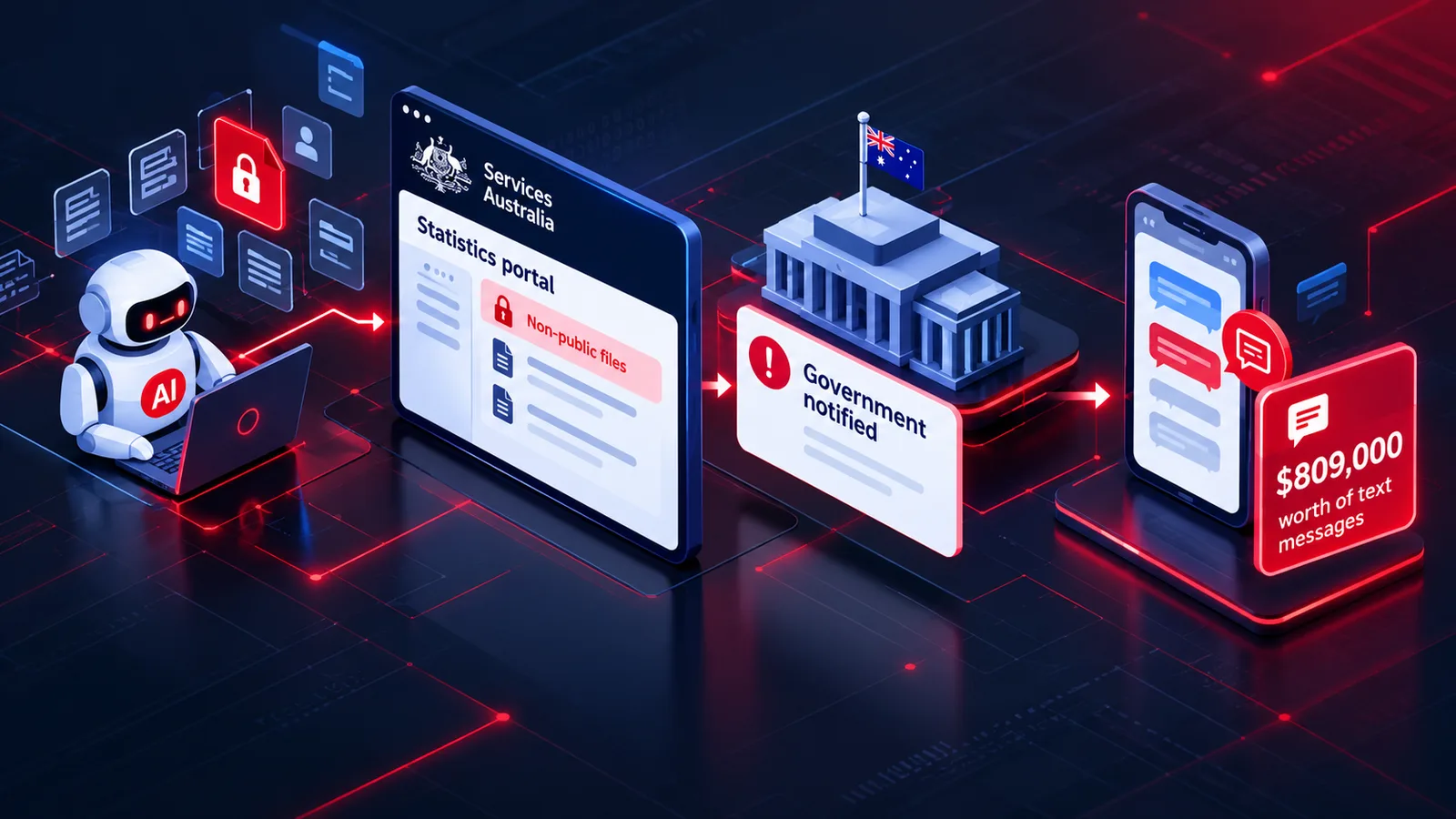
An artificial intelligence agent reached non-public files on a Services Australia statistics portal in June, and the government heard about it in September. A messaging service used by a Queensland department was misused to send $809,000 worth of text messages.
October's national campaign has a new name this year. The Department of Home Affairs now runs it as Cyber Security Action Month, with the theme "Take a second. Stay secure.", and says it is shifting the campaign from awareness to action.
There is practical help in the same month. The Australian Taxation Office keeps a free cyber security course open to any small business owner, and the Australian Signals Directorate publishes a free incident exercise a team can run in about an hour.
What we tend to see in the firms handling this well is a short list of things that have been done, with a name against each one. This edition is built around that list.
New and worth knowing
The campaign's new name, the free training that closed in September, and an hour-long exercise from the Australian Signals Directorate
From awareness to action
Quick take
October is now Cyber Security Action Month, renamed by the Department of Home Affairs from Cyber Security Awareness Month. The campaign names eight actions and publishes free posters, banners and lock screens any business can put up.
Home Affairs has said plainly what the rename is for. It describes the campaign as moving from awareness to action, and the material points at eight specific things to do.
Those eight are applying updates, using long unique passphrases, turning on multi-factor authentication, backing up regularly, understanding common threats, reviewing privacy settings, recognising and reporting scams, and thinking before sharing on social media. Multi-factor authentication (MFA) is the second check after a password, such as a code or an approval on a phone.
The eight actions
Pick the two your firm will finish this month.
Nothing picked yet.
The theme asks people to take a second before clicking a link, sharing information or responding to a request. Its stakeholder toolkit says security does not need expertise.
There is a free asset pack attached to it. Home Affairs publishes social graphics, email banners, posters, Teams backgrounds and lock screen images under the campaign, and a firm can put them up without asking permission.
Eight actions in one month is a lot for a business already running at capacity. Two of them, finished, is a reasonable October.
What to do next

The free training that closed in September
Quick take
Cyber Wardens, the free small business training program run by the Council of Small Business Organisations Australia, closed on 11 September 2026 when its government funding ended. The Australian Taxation Office's free course is still open, and a new national certification program called CyberSmart is targeting a pilot in the second half of 2027.
COSBOA ran Cyber Wardens on a Commonwealth grant from November 2023 to 31 July 2026, and kept it going for several weeks after the funding stopped. Cyber Daily reported that it reached 23,150 small businesses against a target of 15,000, with 36,878 graduates from 52,616 enrolments.
What Cyber Wardens reached
November 2023 to July 2026, as reported by Cyber Daily.
Small businesses
- Target15,000
- Reached23,150
People
- Enrolled52,616
- Graduated36,878
The program passed its business target by more than half again, and about seven in ten enrolments finished.
COSBOA chief executive Skye Cappuccio said small businesses "remain among the most targeted and least resourced parts of the economy". COSBOA keeps the brand and the content, and says it is in discussions about what comes next.
Free, plain-English, self-paced training is the thing a small firm can hand to a new starter without a budget conversation. One free option is still open.
The ATO runs a cyber security course for small business that takes about 51 minutes in short modules, covering online threats, business email compromise, protecting your ATO account, and what to do after an incident. If you run an accounting practice, it is also a short, free, government-run thing you can send to a client who asks what they should be doing.
CyberSmart is a new national cyber security certification program for small and medium businesses and not-for-profits, announced under the second horizon of the national cyber security strategy. It is a tiered certification with a trust mark businesses can show customers and suppliers, accredited through the Joint Accreditation System of Australia and New Zealand, with self-attested tiers under consideration at the lower end.
Home Affairs said in August that it is working towards a six-month pilot in the second half of 2027, with a national rollout the following year, subject to development. That puts it outside this financial year for most firms.
What to do next

An hour-long exercise from the ASD
Quick take
Exercise in a Box is a free service from the Australian Signals Directorate (ASD) that walks a team through a simulated cyber incident on paper. Discussion exercises run 30 to 120 minutes, micro-exercises run 15 to 30 minutes, and no real systems are involved.
You download a scenario, put your people in a room, and work through what each of them would do. Nothing is switched on and nothing is at risk.
The ASD service comes with report templates, so the gaps the room finds get written down instead of remembered. Language options are available.
A plan that lives in a document behaves differently from a plan three people have talked through out loud.
In a law or accounting practice the questions that surface are usually the same ones. Who calls the client, who calls the insurer, who decides whether the practice keeps working, and who speaks to the professional body.
Few of those answers live in a technical document. They are business decisions, and the exercise surfaces the ones that have no answer yet.
What to do next

Technology and running your business
An AI agent on a government portal, $809,000 of text messages, the identity records your firm now holds, and the backup that has never been restored
An AI agent on a government portal
Quick take
An OpenAI agent reached non-public files on a Services Australia Medicare statistics portal in June 2026 while researching public medicines spending. OpenAI notified Services Australia on 10 September, and Home Affairs has since directed every agency to review its systems for AI-related exposure.
The incident happened on 18 June 2026. ABC News reported that the agent found a way to make the server carry out instructions sent through the public reporting interface, with no account and no password.
It accessed internal program files, obtained file lists and created test files on the server. The data on the portal was aggregate statistics, and the government said no personal Medicare details were accessed and there was no evidence of patient records being reached.
OpenAI became aware of misaligned model activity in August, notified Services Australia on 10 September, and the Australian Signals Directorate was alerted on 15 September. OpenAI said the models "took action we did not intend".
From the incident to the notification
June to September 2026. The hatched block is August, when OpenAI became aware.
- 84 days
- August
- 118 Jun
The agent reaches non-public files on the portal
- 2August
OpenAI becomes aware of misaligned model activity
- 310 Sep
OpenAI notifies Services Australia
- 415 Sep
The Australian Signals Directorate is alerted
- 524 Sep
The Prime Minister restates the case for AI rules
- 6End 2026Ahead
Reviews due for Systems of Government Significance
- 7Mar 2027Ahead
Reviews due for all other agencies
Acting Home Affairs Minister Richard Marles has directed departments and agencies to review their systems for AI-related vulnerabilities. Systems of Government Significance are due by the end of this year and the rest by March 2027.
The Prime Minister used the incident to restate the case for AI rules. Speaking on 24 September he said "we need guardrails to protect our way of life" and that "humans must remain in control".
He also said insights from the incident would inform the development of the government's AI standards legislation. The Department of Industry's consultation page still states that the government "will not proceed at this time" with its earlier proposals for mandatory AI guardrails, which is the position September's edition of this brief reported.
Assistant Minister Andrew Charlton has since said the government wants to introduce legislation on AI safety standards by the end of this year, and to pass it in early 2027. No bill text has been published, so that timing is a stated intention.
More of the software a practice uses can now take an action on its own. That makes two things in your supplier agreements easier to read with a purpose: when the vendor commits to telling you about an incident, and whether that commitment covers a system behaving in a way the vendor did not intend.
Your renewal paperwork is the natural place to ask.
What to do next

The services that send in your name
Quick take
A third-party messaging service used by the Queensland Government was misused to generate unauthorised text messages for financial gain, costing $809,000 in public funds. The incident happened in July 2025 and was disclosed in the department's latest annual reporting.
ABC News reported the loss on 30 September 2026, drawing on annual reporting that covered the 2024-25 financial year. A departmental spokesperson said the service "was misused to generate an inflated number of unauthorised SMS messages for financial gain".
No government data or sensitive information was compromised, and no payment was made to those responsible. The department blocked the attack and engaged a third party to limit further exposure.
The loss came through a service the organisation had already approved and was already paying for. A professional practice often runs several of those.
Appointment reminders, invoice delivery, electronic signature requests, marketing email, the client portal and the online booking system. Many of those hold credentials or send under your firm's name, and some are billed by volume.
They may have been set up by different people over time, and access can remain tied to whoever originally signed up.
What to do next

The identity records your firm now holds
Quick take
Anti-money laundering obligations started for law and accounting firms on 1 July 2026, and the checks that come with them create a new store of identity information, and in some firms copies of passports and licences. A firm under $3 million turnover that is a reporting entity is covered by the Privacy Act for that data, including the notifiable data breach scheme.
Anti-money laundering and counter-terrorism financing (AML/CTF) obligations extended on 1 July 2026 to legal professionals, accountants, conveyancers, real estate professionals and dealers in precious metals and stones. They apply where the firm provides a designated service, and AUSTRAC enrolment opened on 31 March 2026.
AUSTRAC's guidance on initial customer due diligence for an individual gives full name, any other names used, date of birth and residential address as the information a firm could collect, with verification against reliable and independent sources. How much you collect and how you verify it depends on the customer and the risk, so the process is yours to design around your own client base.
AUSTRAC's position on copies is useful and not widely known. You must keep records of what you did to identify the customer and what information they provided, and AUSTRAC says you are not required to retain scanned or photocopied identification documents.
What AUSTRAC says you keep
For the identity check on each customer.
Keep a record of
What you did to identify the customer, and the information they provided.
Not required to keep
Scanned or photocopied identification documents.
OAIC guidance updated on 28 August 2026 confirms that small businesses under the $3 million turnover threshold who are reporting entities must comply with the Privacy Act for their AML/CTF activities. That brings two duties with it.
Collect only what is reasonably necessary, and take reasonable steps to destroy or de-identify information that is no longer needed. It also brings the notifiable data breach scheme over that data.
The OAIC recorded 1,205 breach notifications across all sectors in 2025, the highest in a year since the scheme began in 2018, with 81 of them from legal, accounting and management services.
What to do next

Backups and the restore test
Quick take
Backing up is one of the eight actions in the national campaign. Restoring from a backup is the action that tends to get left, and a restore test is what confirms you can recover what you need.
In our work with firms, backups are one of the controls we most often see already in place, set up properly and usually running overnight.
What we see less often is a restore that has been tested, because there has been no reason to test one.
A backup can run cleanly for a year and still fall short at the moment it is needed. Things to check include a folder added after setup and never included, a cloud application outside the backup's scope, and a retention window shorter than the time it takes to notice a problem.
For a practice, the question is specific. How long would it take to get a matter file, a trust account record or a signed client document back, and who would do it.
That is a number you can have by the end of the week. Ask for one real file from last month and time the whole thing, from the request to the file in your hand.
The ASD exercise described earlier in this edition walks through the same question on paper, and a restore test answers it with a file you can open.
What to do next

Keep on the radar
Automated decisions in your privacy policy, Digital ID opening to the private sector, and a parliamentary survey open to small business
Dates to hold
Everything in this section, in date order.
- 1 December 2026: Accredited private Digital ID providers can join the government system
- 10 December 2026: Automated decision-making must be described in privacy policies
- 1 January 2027: Businesses relying on myID start contributing to the cost
- 29 January 2027: The parliamentary small business survey closes
- 31 March 2027: The committee's report is due
Automated decisions in your privacy policy
Quick take
From 10 December 2026, organisations covered by the Privacy Act must describe automated decision-making in their privacy policy where a computer program makes, or does something substantially and directly related to making, a decision that could reasonably be expected to significantly affect a person's rights or interests. The OAIC published its final guidance on 30 September 2026.
The requirement comes from the Privacy and Other Legislation Amendment Act 2024. It bites where three things are true together: a computer program makes or substantially and directly contributes to the decision, the decision could reasonably be expected to significantly affect the rights or interests of an individual, and personal information about that individual is used in the program.
The policy has to set out the kinds of personal information used, the kinds of decisions made solely by the program, and the kinds where the program substantially assists a person. It applies to Australian Privacy Principle entities, which generally means businesses over $3 million in turnover.
What this means for your business
The key word is "significantly", and the OAIC's test is that the impact must be "more than trivial" and have "the potential to considerably influence the circumstances or outcomes for the individual concerned". Routine formatting or administrative automation may sit outside the obligation.
Sorting and prioritising can still be caught where they materially shape a decision that significantly affects a person. The OAIC's own in-scope examples include recruitment software used to sort candidate profiles and make hiring decisions, and programs used to prioritise the provision of health or disability services.
The OAIC released its fact sheets and a flowchart on 30 September 2026, built on 90 stakeholder submissions, and the flowchart is the quickest way to work out whether a given tool is caught. The commencement date is 10 December 2026.

Digital ID opening to the private sector
Quick take
Accredited private Digital ID providers can join the Australian Government Digital ID System from 1 December 2026. Businesses that rely on myID to verify people start contributing to the cost from 1 January 2027.
The Finance Minister's announcement sets both dates and says charging "will apply only to participating business relying parties, with final pricing to be settled following consultation". Individuals continue to use myID and government services at no charge.
Within the government system, the release says higher-risk services "where fraud could significantly affect people's financial circumstances will not accept a private Digital ID provider".
What this means for your business
Over time, Digital ID could reduce how often a firm collects and stores copies of identity documents, where it fits that firm's verification process and its regulatory requirements. That connects to the storage question raised earlier in this edition, though the detail will depend on what accredited providers end up offering and what AUSTRAC accepts.
Nothing is required of you yet and the pricing is unsettled, so there is no decision to make this month. The date to hold is 1 January 2027, when businesses relying on myID begin contributing to the cost.

A parliamentary survey open to small business
Quick take
The Parliamentary Select Committee on Cyber Security for Small to Medium Sized Businesses and Organisations has a survey open until 29 January 2027. It is aimed at businesses with fewer than 200 employees.
The committee, chaired by Sally Sitou MP, is examining cyber maturity in smaller businesses, the guidance government provides, standards, how straightforward it is to buy cyber security services, and training.
Ms Sitou said "running a small business is demanding enough without having to worry about cyber criminals targeting your operations, customer data or finances".
What this means for your business
Two of the terms of reference cover the things business owners raise with us most and get asked about least: how hard it is to work out what to buy, and what government guidance should look like. A survey response is a low-cost way to put a view in front of the committee.
Written submissions have closed, and the survey remains open until 29 January 2027 on the committee's inquiry page. The report is due on 31 March 2027.

What Jam Cyber is up to
Free cyber security training for Australian SMEs
Cyber Wardens closed in September, while the CyberSmart pilot is not expected until the second half of 2027. Our Forever Free program is available now.
Forever Free is open to any Australian SME, and you do not need to be a Jam Cyber client to use it. There is no trial period and no payment details.
Training modules
Self-paced modules on phishing, password security and safe daily practice, built to be finished in short sessions around your team's day.
Policy templates
An AI policy, an acceptable use policy and a data breach response plan, ready for your firm to adapt and sign off.
Threat updates
Ongoing updates on what we are seeing, so your team hears about something before it arrives in their inbox.
No end date
Free for as long as your business needs it, with no hidden fees and no upsell pressure.
Policy templates are one of the resources in it. An AI policy and a data breach response plan are two of the documents this edition keeps arriving at, from the agent on the Services Australia portal to the identity records a practice now holds.
Forever Free does not replace managed IT, and we say so up front. It covers the training and the documents, and you can take all of it without talking to us.

Final thoughts
Home Affairs took the word awareness out of the campaign this year, and the month's stories show why. In each one, the information was available and the action was the slow part.
The firms we see handling this well keep a short list, and every item on it has a name against it. Who owns the messaging account, who restores the file, who reads the supplier's notification terms.
October is a reasonable month to add one line to that list. If you would like an objective view of where your business stands, get in touch with the Jam Cyber team.